I've been watching this hollow on daily walks for a couple of months now. I've seen a few adult screech owls hanging out there, and for a few weeks it had been empty, until a few days ago.
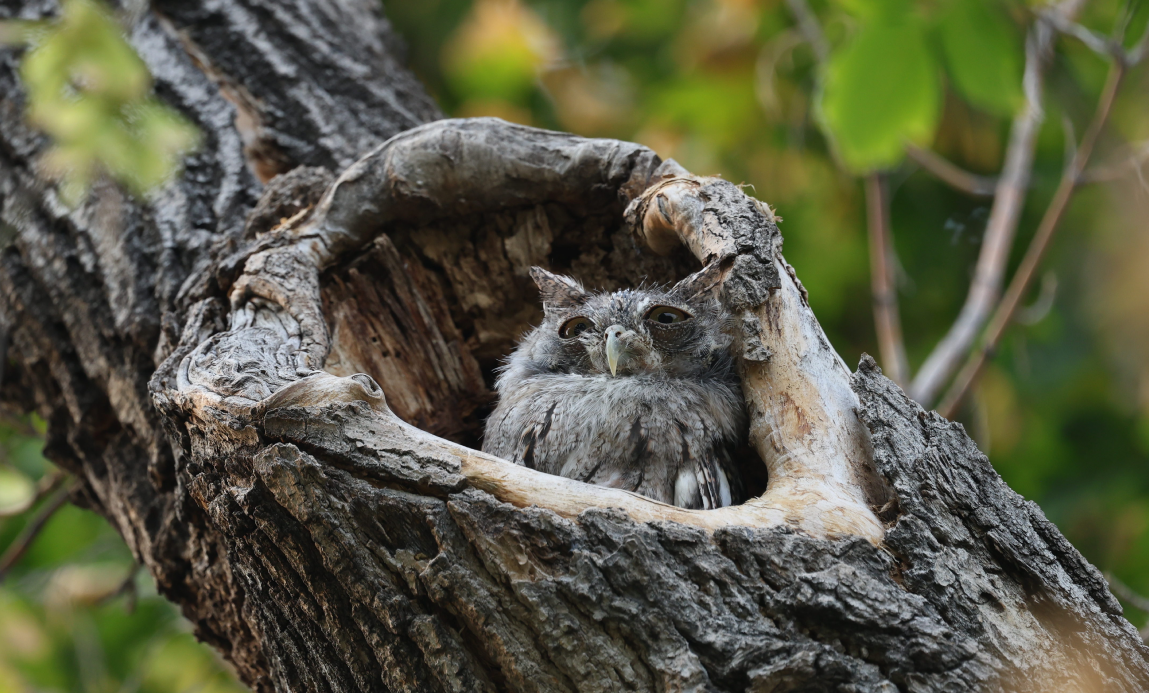
At first, because of the lack of feathers and its odd appearance, I thought it might be an owlet. It didn't look like any of the chicks in the references I checked, my wife figured it out, it was a molting adult... and owls apparently do this in stages, and this gives them a very distinct look.. something like a gremlin or maybe what inspired the designs for Furbies.
What I read about owls molting
All birds replace their feathers, and owls are no exception. What is a little different about owls is the constraint they molt under. A feather that is missing or growing back is a feather that is not producing lift or muffling sound, and both of those matter for a bird whose entire hunting strategy depends on approaching prey silently in low light. Dropping every flight feather at once, the way ducks do during their flightless period, would be a real problem for an owl. So the molt is spread out.
In screech owls this takes the form of a slow, staggered annual molt. The large flight feathers on each wing are dropped in a set sequence over weeks, one or two at a time, and always in matched pairs across the left and right wing so the bird stays balanced in the air. New feathers grow in behind them inside a keratin sheath that eventually flakes away, which is where the pin feather look comes from. The body feathers turn over on a looser schedule and can be replaced more or less continuously, which is the part doing most of the work in making the bird look scruffy.
The timing is usually late summer, after breeding is finished, because a molt is expensive. Growing feathers costs protein and energy, and the bird is running slightly less efficient equipment while it is happening, so it makes sense to sit the process on top of a stretch when nights are warm, prey is abundant, and there are no chicks left to feed. The whole thing takes a few months and the bird comes out the other side looking sleek again.
The reason a molting adult reads so much like a chick at first glance is that both are running on a plumage that hasn't quite settled. Chicks are still transitioning from natal down to their first proper feathers. Adults in molt have the full adult plumage, just in mixed states of old, new, and missing all at once. The way to tell them apart, once you know to look, is size and proportion. A molting adult has the full-sized head, eyes, and feet of a grown bird sitting inside a coat that is briefly the wrong texture. A chick is smaller and softer everywhere at once.
About the photograph
The owl was sitting right at the entrance of the hollow with the leaves behind it lit up in the afternoon, which is the opposite of the usual problem with these birds. Most encounters are in low light with the animal tucked back inside a dark cavity, where any flash or bright torch either washes out the texture that makes the shot worth taking or pushes the owl deeper into the hollow.