Wildlife photographers are usually cagey about specific locations, and for good reasons. Once a spot gets shared beyond a small circle, the animal loses whatever privacy it had, and even well-intentioned foot traffic can be enough to push a nesting bird or a denning marsupial off a site it would otherwise stay on. I follow the same rule, and I usually take some time to size somebody up before mentioning what I've seen and where.
The way I found out about ghost mushrooms is because someone else made the same judgement call about me, which is the best possible outcome of that etiquette. I was out with my wife looking for a powerful owl, which is a large nocturnal predator that lives in a few forest patches around here and is famously hard to actually put eyes on. We ran into a few people along the trail, and one of them was also there for the owl. Something clicked, and we spent a good chunk of the evening chatting and comparing notes on where each of us had been checking. The owl didn't turn up for any of us that night, but before we left he offered to show us something else that most people don't know is even in the area, and we arranged to meet him the next evening at the edge of a nearby forest where a bike trail runs along the tree line.
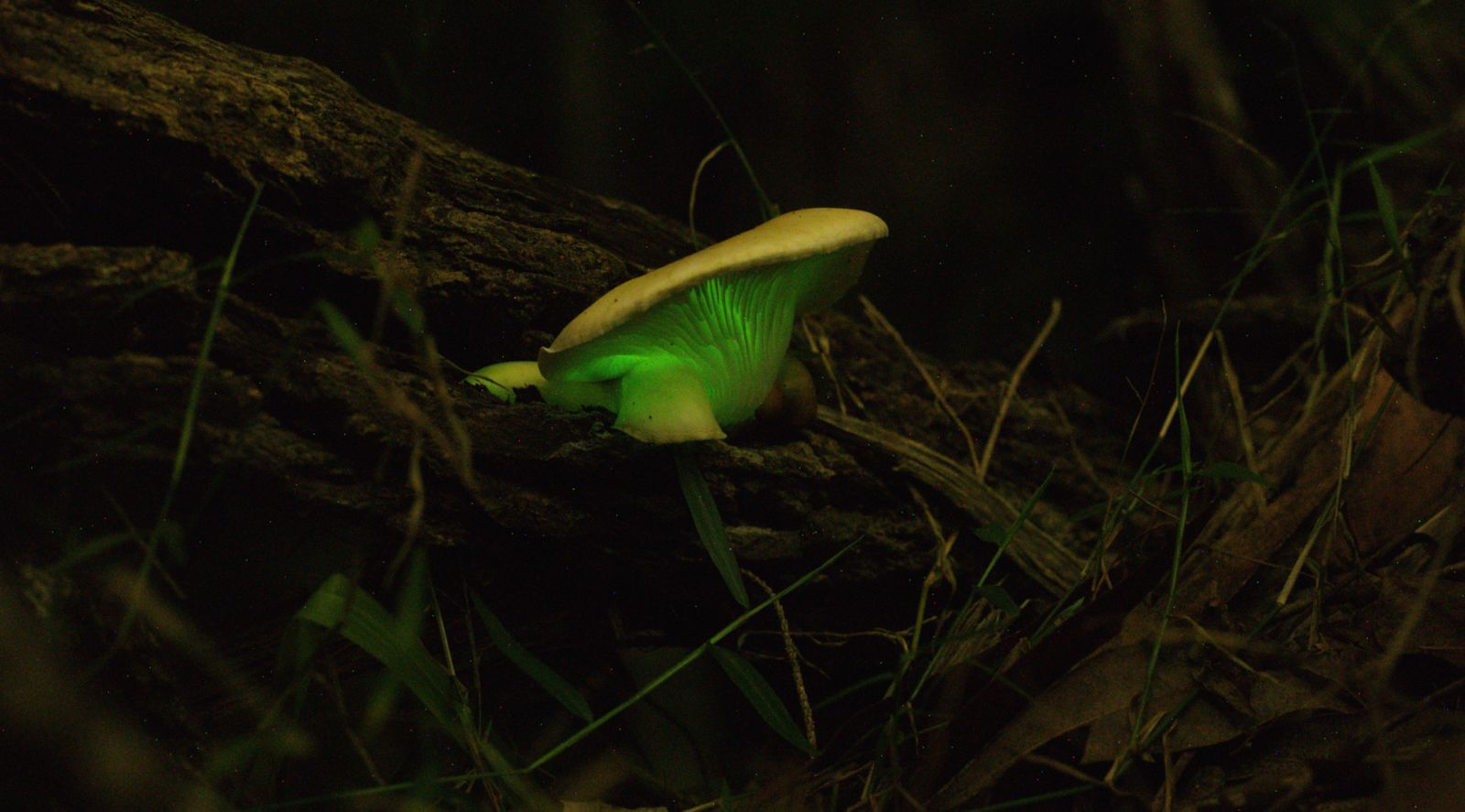
When we got there he killed his torch and waited for our eyes to adjust. A small cluster of were growing on fallen eucalypus log right next to the trail, glowing faintly (to the naked eye) green from underneath the gills. That was the first time either of us had seen a bioluminescent mushrooms in the wild.
What I learned that night and then went home to read up on
The species is Omphalotus nidiformis, a native Australian fungus that fruits on decaying eucalyptus wood, usually on old stumps and fallen limbs where the timber has been sitting long enough for the internal structure to break down. It's a close relative of the northern hemisphere jack-o'-lantern mushroom, and like its cousin the entire fruiting body glows continuously once it's mature, without needing any external trigger.
The glow is chemical rather than reflective. Inside the tissue a molecule called 3-hydroxyhispidin is oxidised by an enzyme in the luciferase family, and the reaction gives off cool green light with very little waste heat. Fireflies use a different luciferin molecule from fungi, but the underlying trick (an enzyme cracking energy out of a substrate and shedding the excess as visible photons) evolved independently in both lineages, which is one of those small pieces of biology that gets more interesting the longer you look at it.
We aren't fully sure why fungi bother glowing, the most cited hypothesis is that the light attracts nocturnal insects at ground level, and those insects then pick up spores and carry them elsewhere, which would make the bioluminescence effectively a nighttime dispersal signal rather than a defence or a warning. It's plausible and there's supporting evidence, but it isn't the last word, and part of what's charming about ghost mushrooms is that a fully agreed answer for "what is this actually for" doesn't quite exist yet.
The viewing window is pretty narrow, they fruit in late autumn through winter, mostly a few days after decent rain has soaked the wood they're growing on, and any individual mushroom only glows brightly for two or three nights before the cap begins to slump and the whole fruiting body deteriorates.
About the photograph
The green in that frame is real, but it's very faint. Standing in front of a fresh ghost mushroom you can see the glow with dark-adapted eyes, though it's dim enough that any nearby light source (a phone screen, a passing headlamp, a brighter than expected moon) drowns it out completely. This shot is a multi-second exposure at high ISO with every stray light source off, and the fungus itself is doing the rest of the work with no colour manipulation applied.